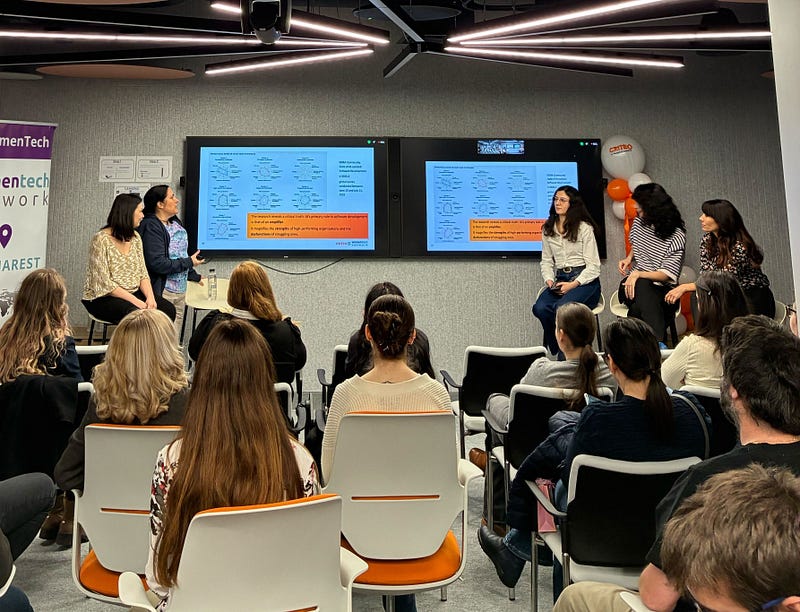





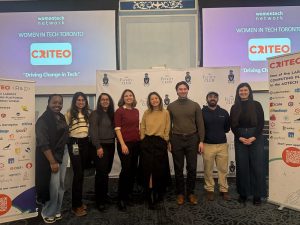




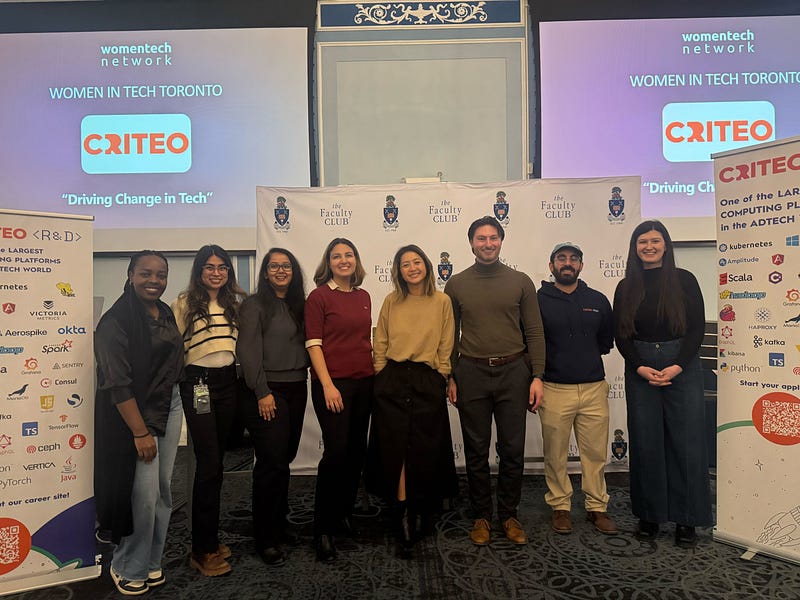
Our team at Criteo Toronto partnered with the WomenTech Network Toronto chapter to curate an event titled “Driving Change in Tech” with a focus on “People, Technology, and Leadership”.
The event had a technical keynote followed by a panel discussion, both of which were quite engaging and full of insight! Here’s a brief recap:
The 1st part of the technical keynote was on the topic of “Re-architecting Legacy Systems” delivered by Senem Isik — Sr Engineering Manager, where she focused on the decision-making process of re-architecting system designs and getting the necessary buy-in, when and how to pivot, incremental delivery, and shared some tips on executing a re-architecture project. Here are a few ideas that stuck with me:
- If you are consistently experiencing a decline in delivery velocity, if there’s an increase in issues in production that have direct client impact, or if there are no clear team boundaries — these can be crucial deciding factors that indicate the need for a system re-architecture.
- Agile plans are key to successful pivots — you should be able to make the plan, execute the plan, expect the plan to go off the rails, and [if that happens] throw away the plan. s/o Leonard Snart
- An example of incremental delivery can look like moving from a Monolith to a Modular to a microservice architecture.
- Sprint 0 — aka let the team form, storm, and norm — should be a household name before kicking off execution. This is often the initial, unofficial phase of a project where a newly formed team establishes a ‘’rhythm” before the official Sprint 1 begins. In Criteo, for example, a re-architecture project can sometimes be worked on by “V-Teams” aka virtual teams, that are temporarily created for the project, and which draw engineers from different (already existing) teams. In such scenarios, it is crucial to ensure that Sprint 0 is not skipped.

The 2nd part of the technical keynote was presented by Justeen Randev — Software Development Engineer, who drilled into How BDD (Behaviour Driven Development) can help women engineers show impact. I quite enjoyed this section because being able to show tangible impact is a powerful way of spotlighting your work and value to the business, which in turn can positively influence growth in the workplace. Here are some key points from this session:
- BDD is human-readable, hence it provides a shared language for expected behaviour. This, in turn, ensures shared understanding when working with a diverse team of, say, PMs, designers, testers, etc. It can also provide a point of reference when team members join and leave the team mid-project.
- BDD can help boost confidence in multiple ways because of the positive effects that it has; makes invisible engineering decisions visible, shows intent, logic, and completeness, you can easily defend your work, faster agreements, reduces uncertainty of tasks being worked on, etc.
- Check out the Given-When-Then BDD example if you’d like to incorporate this into your work!

The final part of the event was a panel that brought together the theme of the event and focused on “People, Technology, and Leadership”. The panel constituted Hilary Kwok (Talent Acquisition Leader), Senem, Justeen, and me. Here are some key takeaways from the panel discussion:
- Having a clear why when embarking on a technical change, re-architecture, or project update makes it easier to have buy-in from stakeholders.
- Using available tools and patterns, such as the BDD method mentioned above, is a great way of driving change without authority, building visibility for your work, and having tangible results.
- Hiring is shifting as technology shifts, signaled by a change in intake conversations and the addition of structured signals in the interview process.

I thoroughly enjoyed being a part of this event and taking in all the great tips shared by the speakers! I’ll leave you with a question that I posed to the attendees at the event:
What do you think will be the first to break during a transformation? People, Process, or Technology?
Diversity is a big deal here at Criteo — in 2025, 41% of Criteos were women, and 21% of them specifically in tech roles. We continue to put in significant effort to improve these numbers, which is why this event was timely! (also, one of the key factors I took into consideration before joining!)
See you at the next one!