















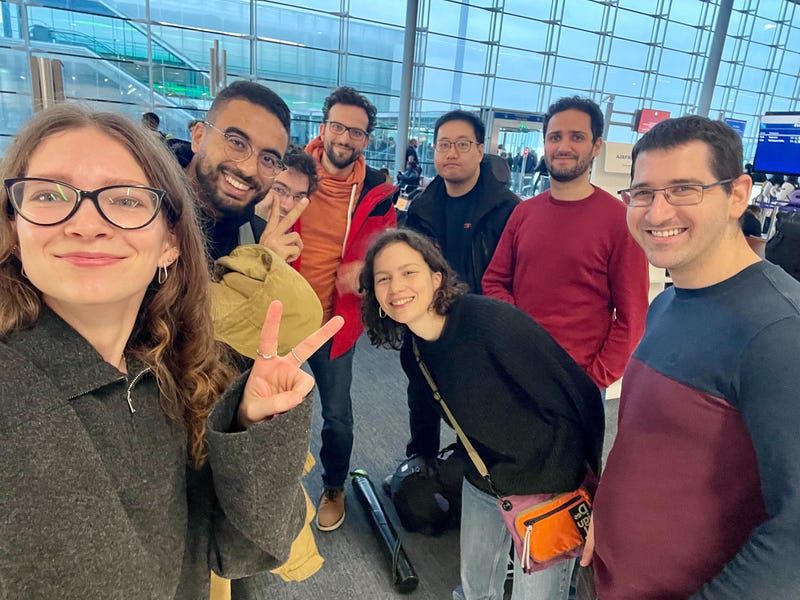
This year, our research team got a record of 15 papers accepted at the major ML conference.
The 38th annual edition of the prestigious international conference NeurIPS 2024 (Neural Information Processing Systems) took place in Vancouver. 𝗥𝗲𝘀𝗲𝗮𝗿𝗰𝗵𝗲𝗿𝘀 𝗳𝗿𝗼𝗺 𝘁𝗵𝗲 𝗖𝗿𝗶𝘁𝗲𝗼 𝗔𝗜 𝗟𝗮𝗯 were there to present their latest ML papers (𝟭𝟯 𝗽𝗮𝗽𝗲𝗿𝘀 — 𝗮𝗺𝗼𝗻𝗴 𝘄𝗵𝗶𝗰𝗵 𝗼𝗻𝗲 𝘀𝗽𝗼𝘁𝗹𝗶𝗴𝗵𝘁 — , 𝟭 𝗱𝗮𝘁𝗮𝘀𝗲𝘁 𝗽𝗮𝗽𝗲𝗿, 𝟭 𝗰𝗵𝗮𝗹𝗹𝗲𝗻𝗴𝗲 𝗽𝗮𝗽𝗲𝗿).
Initial remarks by Liva Ralaivola (VP Research)
Our papers bring original AI contributions on topics a leading AdTech company like Criteo must have expertise on — online learning, bidding, pricing, dataset valuation, fairness, and deep learning.
That’s what we do here at Criteo. We are leading the way for others with an academic center of technical and scientific research. We target 𝗲𝗻𝗱-𝘁𝗼-𝗲𝗻𝗱 𝗔𝗜 (for AdTech) proficiency from 𝘂𝗽𝘀𝘁𝗿𝗲𝗮𝗺 𝘂𝗻𝗱𝗲𝗿𝘀𝘁𝗮𝗻𝗱𝗶𝗻𝗴 & 𝗰𝗿𝗮𝗳𝘁𝗶𝗻𝗴 𝘁𝗵𝗿𝗼𝘂𝗴𝗵 𝗽𝗿𝗼𝗱𝘂𝗰𝘁 𝗶𝗻𝘁𝗲𝗴𝗿𝗮𝘁𝗶𝗼𝗻 𝘁𝗼 𝗿𝗼𝗯𝘂𝘀𝘁 𝗱𝗲𝗽𝗹𝗼𝘆𝗺𝗲𝗻𝘁.
We do that within a concerted and exciting R&D x Product x Sales effort. Because as H.E. Lucckock put it, “𝘕𝘰 𝘰𝘯𝘦 𝘤𝘢𝘯 𝘸𝘩𝘪𝘴𝘵𝘭𝘦 𝘢 𝘴𝘺𝘮𝘱𝘩𝘰𝘯𝘺. 𝘐𝘵 𝘵𝘢𝘬𝘦𝘴 𝘢𝘯 𝘰𝘳𝘤𝘩𝘦𝘴𝘵𝘳𝘢 𝘵𝘰 𝘱𝘭𝘢𝘺 𝘪𝘵.”
Criteo contributions
Check out all our contributions, with some of them commented on by their authors.
Logarithmic Smoothing for Pessimistic Off-Policy Evaluation, Selection and Learning. (Spotlight paper 🌟)
We are excited to share our recent work on logarithmic smoothing for pessimistic off-policy evaluation, selection, and learning, which offers a fresh perspective on how to confidently improve policies in interactive systems using historical data. In this study, we move beyond standard point estimators and introduce novel, fully empirical concentration bounds for a broad class of importance-weighting risk estimators — an approach that not only unifies existing methods but also paves the way for new ones.

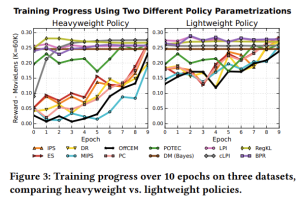
Building on these insights, we propose a new estimator (LS) that leverages logarithmic smoothing for large importance weights, and demonstrate how this leads to tighter bounds compared to its counterparts. The result is a more robust framework for policy selection and learning, enabling practitioners to deploy improved strategies with higher confidence in real-world applications.
We believe these findings highlight the importance of adopting a pessimistic perspective — one that prioritizes worst-case outcomes — to guide policy decisions. By sharing our techniques and extensive experimental results, we aim to advance the state of offline contextual bandit research and help foster more reliable and principled data-driven decision making.
More details 👇
Research Card: Logarithmic Smoothing for Pessimistic Off-Policy Evaluation, Selection, and Learning
We discuss a new method for off-policy evaluation, selection, and learning in interactive systems.
techblog.criteo.com
DU-Shapley: A Shapley Value Proxy for Efficient Dataset Valuation
(Felipe Garrido-Lucero, Benjamin Heymann, Maxime Vono, Patrick Loiseau, Vianney Perchet)
We are thrilled to present our work on dataset valuation. Datasets are the lifeblood of AI, and often, merging multiple datasets is crucial for enhancing model performance. As contributors of datasets increase the model’s value, the question arises: how should the benefits be fairly distributed?

Fortunately, game theory offers a principled solution through the Shapley value. However, applying the Shapley value in this context is computationally intractable. In our work, we simplify the Shapley value calculation to make it feasible for dataset valuation, providing a practical approach to assessing and allocating the value contributed by each dataset.
This work will be key to shape the future of data markets. https://arxiv.org/pdf/2306.02071
Optimizing the coalition gain in Online Auctions with Greedy Structured Bandits
(Dorian Baudry, Hugo Richard, Maria Cherifa, Vianney Perchet, Clément Calauzènes)
We are excited to share our work on optimizing the gain of a coalition in repeated second-price auctions. In this problem, we take the point of view of a central agent that decides how many participants (from the same team) should be sent to participate in a second price auction against a known number of competitors. All participants are assumed to bid according to an identical (but unknown) distribution. Intuitively, if many members of the coalition participate, they will compete against each other leading to a small gain when the auction is won. On the other hand, if the coalition sends only a few members, the likelihood of winning the auction is low. The goal is then to optimize the number of members to send. We design new concentration inequalities and propose an algorithm that has constant regret (this is an upper bound on the performance that does not depend on the number of repeated auctions).
Optimizing the coalition gain in Online Auctions with Greedy Structured Bandits
Motivated by online display advertising, this work considers repeated second-price auctions, where agents sample their…
hal.science

Improved learning rates in multi-unit uniform price auctions
(Marius Potfer, Dorian Baudry, Hugo Richard, Vianney Perchet, Cheng Wan)
We are excited to share our work on learning how to bid in repeated multi-unit price auctions. In this type of auction, K identical items are for sale. Buyers simultaneously reveal their bids i.e. the price they are willing to pay to acquire 1, 2, …, K items. The seller then sets the price to be equal to the K-th highest bid and gives the items to the highest bidding buyers. In this work, we take the point of view of one buyer and see other buyers as an oblivious adversary. Thanks to a new modeling of the bid space, we designed a new algorithm that reaches better theoretical performance (as measured by the expected regret) than previous approaches. More precisely our performance is optimal in terms of its dependence on the number of auctions (horizon).

Improved learning rates in multi-unit uniform price auctions
Motivated by the strategic participation of electricity producers in electricity day-ahead market, we study the problem…
arxiv.org
FairJob: A Real-World Dataset for Fairness in Online Systems
(Mariia Vladimirova, Federico Pavone, Eustache Diemert)
We are proud to be the first to open-source a fairness-aware dataset for advertising, one of the largest fairness-aware tabular datasets released by a company. In our research, we provided an in-depth analysis of where unfairness can arise throughout the advertising process, offering insights that had not been previously explored with such detail, all based on our internal studies.

Building on these findings, we introduced a novel utility metric that accounts for selection bias and shared reproducible experimental results using the open-sourced dataset.
Our study highlights the potential presence of market bias, which could have far-reaching implications for the entire advertising ecosystem. We believe that our work will contribute to the advancement of responsible advertising and provide greater transparency into its underlying processes.
More details 👇
Research Card: FairJob – A Real-World Dataset for Fairness in Online Systems
Research Card on how to make the outcome prediction in online systems fairer?
techblog.criteo.com
Towards Efficient and Optimal Covariance-Adaptive Algorithms for Combinatorial Semi-Bandits
(Julien Zhou, Pierre Gaillard, Thibaud Rahier, Houssam Zenati, Julyan Arbel)
We are glad to share our work on algorithms for Combinatorial Semi-Bandits. In this work, we explore cases when there is a correlation structure between the rewards of the items to be chosen from.
In particular, we propose two algorithms: OLS-UCB-V and COS-V, designed to leverage this structure. They work by estimating covariance matrices at the same time as they make decisions. These estimations are designed speed-up exploration compared to algorithms not taking them into account. Both algorithms are based on the “optimism” principle. While OLS-UCB-V is deterministic, COS-V also uses a sampling strategy, which makes it more computationally efficient.
Combinatorial bandits are commonly used to model online advertisement use cases (any problem with repeated choices among supersets, like choosing a small basket from a lot of items) and understanding well how to design good strategies for such problems is important for Criteo.
Towards Efficient and Optimal Covariance-Adaptive Algorithms for Combinatorial Semi-Bandits
We address the problem of stochastic combinatorial semi-bandits, where a player selects among P actions from the power…
arxiv.org
Strategic Multi-Armed Bandit Problems Under Debt-Free Reporting
(Ahmed Ben Yahmed, Clément Calauzènes, Vianney Perchet)
We are excited to share our work on Strategic Multi-Armed Bandit Problems Under Debt-Free Reporting. In this study, we consider a setting where the arms are strategic, meaning they are rational entities seeking to maximize their own utilities. Consequently, each arm has the ability to withhold a portion of its reward and report only a fraction of it to the player.

This setting induces a game between the player, who aims to minimize regret, and the arms, which seek to maximize their utilities. In such a framework, classic low-regret multi-armed bandit (MAB) algorithms suffer from linear regret, as a detrimental collusive equilibrium may arise. To address this challenge, we propose an algorithm that combines sequential learning with mechanism design by incorporating incentives to encourage truthful reporting. Our algorithm achieves a truthful subgame perfect equilibrium (SPE), under which the player experiences lower regret compared to existing methods in the literature.
This framework has broad real-world applications, particularly in scenarios where strategic behavior is prevalent, such as in auctions, e-commerce, and other multi-agent systems. It also serves as a generalization of the principal-agent theory to multi-agent settings.
Strategic Multi-Armed Bandit Problems Under Debt-Free Reporting
We consider the classical multi-armed bandit problem, but with strategic arms. In this context, each arm is…
arxiv.org
Don’t miss the rest of our contributions 👇
AROMA: Preserving Spatial Structure for Latent PDE Modeling with Local Neural Fields
(Louis Serrano, Thomas X Wang, Etienne Le Naour, Jean-Noël Vittaut, Patrick Gallinari)
AROMA: Preserving Spatial Structure for Latent PDE Modeling with Local Neural Fields
We present AROMA (Attentive Reduced Order Model with Attention), a framework designed to enhance the modeling of…
arxiv.org
Boosting Generalization in Parametric PDE Neural Solvers through Adaptive Conditioning
(Armand Kassaï Koupaï, Jorge Mifsut Benet, Yuan Yin, Jean-Noël Vittaut, Patrick Gallinari)
GEPS: Boosting Generalization in Parametric PDE Neural Solvers through Adaptive Conditioning
Solving parametric partial differential equations (PDEs) presents significant challenges for data-driven methods due to…
arxiv.org
NeurIPS 2024 ML4CFD Competition: Harnessing Machine Learning for Computational Fluid Dynamics in Airfoil Design
(Mouadh Yagoubi, David Danan, Milad Leyli-abadi, Jean-Patrick Brunet, Jocelyn Ahmed Mazari, Florent Bonnet, maroua gmati, Asma Farjallah, Paola Cinnella, Patrick Gallinari, Marc Schoenauer)
NeurIPS 2024 ML4CFD Competition: Harnessing Machine Learning for Computational Fluid Dynamics in…
The integration of machine learning (ML) techniques for addressing intricate physics problems is increasingly…
arxiv.org
Local and Adaptive Mirror Descents in Extensive-Form Games
(Côme Fiegel, Pierre Ménard, Tadashi Kozuno, Remi Munos, Vianney Perchet, Michal Valko)
Local and adaptive mirror descents in extensive-form games
We study how to learn $ε$-optimal strategies in zero-sum imperfect information games (IIG) with trajectory feedback. In…
arxiv.org
Lookback Prophet Inequalitites
(Ziyad Benomar, Dorian Baudry, Vianney Perchet)
Lookback Prophet Inequalities
Prophet inequalities are fundamental optimal stopping problems, where a decision-maker observes sequentially items with…
arxiv.org
The Value of Reward Lookahead in Reinforcement Learning
(Nadav Merlis, Dorian Baudry, Vianney Perchet)
The Value of Reward Lookahead in Reinforcement Learning
In reinforcement learning (RL), agents sequentially interact with changing environments while aiming to maximize the…
arxiv.org
Improved Algorithms for Contextual Dynamic Pricing
(Matilde Tullii, Solenne Gaucher, Nadav Merlis, Vianney Perchet)
Improved Algorithms for Contextual Dynamic Pricing
In contextual dynamic pricing, a seller sequentially prices goods based on contextual information. Buyers will purchase…
arxiv.org
Addressing bias in online selection with limited budget of comparisons
(Ziyad Benomar, Evgenii Chzhen, Nicolas Schreuder, Vianney Perchet)
Addressing Bias in Online Selection with Limited Budget of Comparisons
Consider a hiring process with candidates coming from different universities. It is easy to order candidates with the…
arxiv.org
Check the next video by Vianney Perchet, a Principal Research at Criteo and professor at Ensae, where he shares his insights on all our contributions at NeurIPS 2024.
Do you want to be part of this amazing team? 👀 👇
Research Intern
What You'll Do: The Criteo AI Lab is pioneering innovations in computational advertising. As the center of…
careers.criteo.com