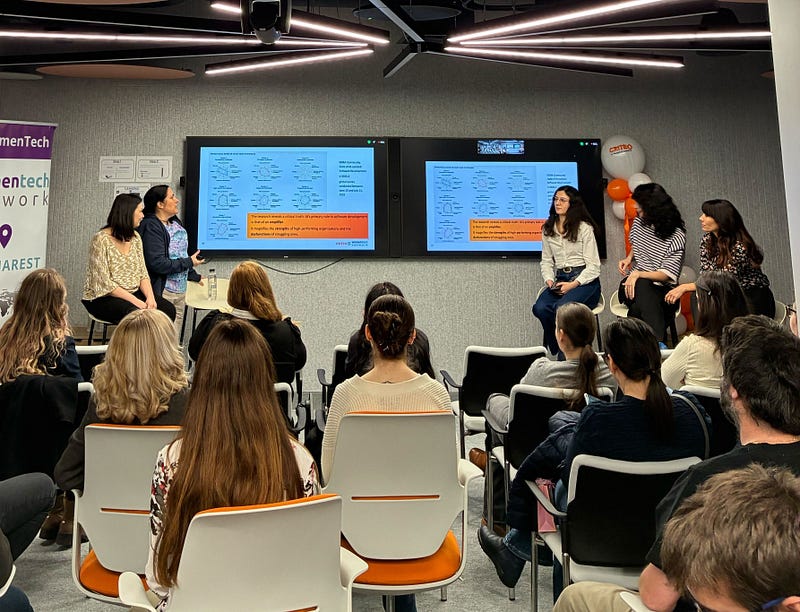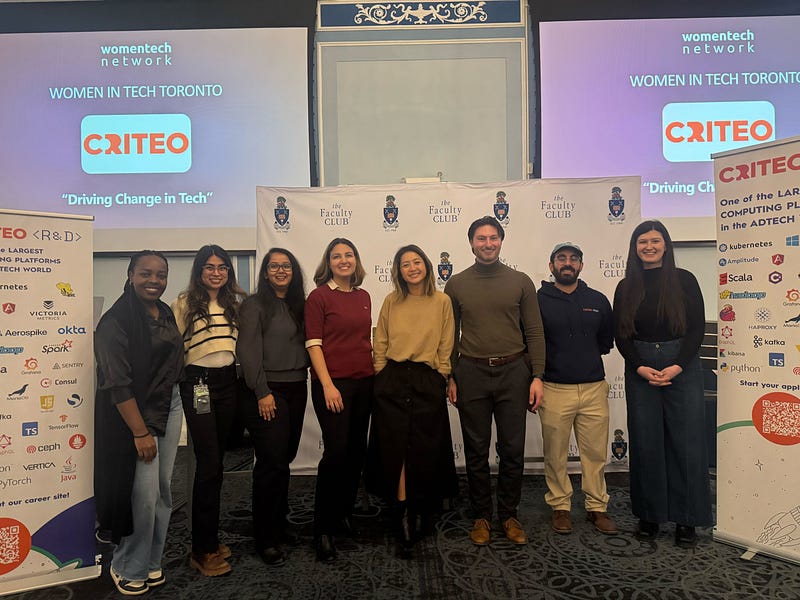






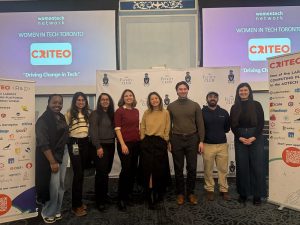



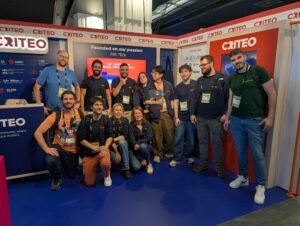



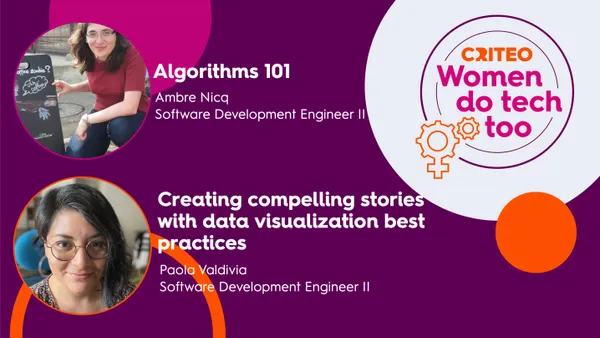
Our “Women do tech too” meetup event gives the floor to women working at Criteo so they can share their technical expertise. It is a unique opportunity to meet, network, and share insights with other passionate women from the tech field. Who can join? Basically, anyone who believes in supporting a more diverse and inclusive future for the tech industry.
On our side, two speakers attended this last edition; Ambre Nicq, who presented an algorithm 101 talk to demystify a complex topic like the “algorithm world”, and Paola Valdivia, who shared basics and advanced practices about data visualization.
Takeaways
If you missed it, here some key takeaways for you:
On June 27, we welcomed over fifty people to our Paris offices and introduced them to who we are, what we do, and how we do it at Criteo.
In a nutshell,
- We are a global tech company which delivers richer experiences through our leading Commerce Media Platform. We combine state-of-the-art technology with business understanding to equip our clients with the best product fits, enabling them to target the right audience at the right time through tailored campaigns.
- To support our core business, we have built a solid Research & Development department with a presence across several countries like France, Spain, the US, Germany, Cyprus, Armenia, and more.
- Our passionate engineering experts are constantly stirring their brains and working on new technologies.
The place of Diversity and Inclusion in the tech industry
Talking about the future for tech, we wanted to share a discussion Alejandra Paredes, Software Developer Engineer, had with Nicolas Laveau, Senior Engineering Manager, regarding his views on Diversity and Inclusion in the tech industry.

Here are the two ideas to remember:
- When hiring a new person, Nicolas explains that diversity does not mean a candidate will not be a good addition to the team. On the contrary, it means they will bring something different and complementary. But he also reminded us that diversity and inclusion are not the same thing, and that we need to find the balance to create a sustainably diverse and inclusive future for the tech industry. Diversity with no inclusion won’t work.
- In his opinion, even though diversity has become more present in company culture and awareness has been raised among recruiters and managers, the road ahead is long, as there is still a lot to be achieved.
Now, moving on to Ambre and Paola’s talks:
Algorithms 101 — How to overcome the misconception around algorithms?
Our first speaker, Ambre Nicq, talked about algorithms and how they can be helpful besides sorting lists. After introducing the topic and its related challenges, she shared some insights:
- Algorithms is solving a problem in a formal way.
- Machine Learning to solve a classification problem is an example of algorithms among others.
- In algorithm, there are many important properties like parallelization or optimality. Also, if your solution impacts people’s lives, it is even more essential to have an explainable algorithm.
- Big O(…) notation is used to describe an algorithm complexity. In this way, it’s important to stay always below or equal to polynomial complexity, and to reason on diminishing it whenever it’s possible
- An example of a complex problem, the garbage collection, which aims to optimize a path, taking the sorter one in the faster time.

Creating compelling stories with data visualization best practices
After Ambre’s talk, we welcomed Paola Valdivia to explore together how to turn confusing visualizations into easy-to-understand visuals that effectively communicate their message.
When dealing with representing data in a clear and ethical way, here are a few best practices she shared with us:
- Choose the right chart type for the case and the audience.
- Y-axis should start at zero (but not always) (e.g., if you are monitoring the temperature of a human being, it is better to adapt your Y-axis value)
- Keep it simple: you want your message clear.
- Annotations and visuals cues: reduce the reader’s effort so they can follow your story more easily.
- Colors: use colours to highlight specific things but be mindful of not reproducing stereotypes (e.g., girls = pink / boys = blue), think about people with colour blindness (e.g., don’t use green colour next to red one) and keep in mind that colours transmit emotions and they don’t convey the same emotions depending on your culture.
- Respect universal schemas: When conveying positive values, we will generally put the data up. On the contrary, with negative values, we will generally put the data down. If you do something different from these universal schemas, explain it before to your audience to ensure your reader doesn’t get confused.

A huge thank you to all who could join us this wonderful day! We also thank our two speakers and amazing team for organizing such a nice event.
Do not miss your chance to discover more inspiring people and join our next “Women do tech too” meetup!
To be part of our meetups communities, click here 👇
CriteoTech Meet – Paris (Paris, France)
As a global leader in personalised digital performance advertising, we rely extensively on the rampant creativity of…
www.meetup.com
CriteoTech Meet – BCN (Barcelona, España)
As a global leader in personalised digital performance advertising, we rely extensively on the rampant creativity of…
www.meetup.com