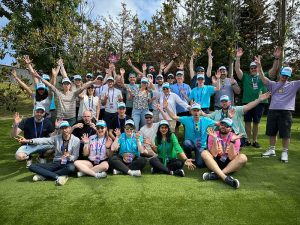





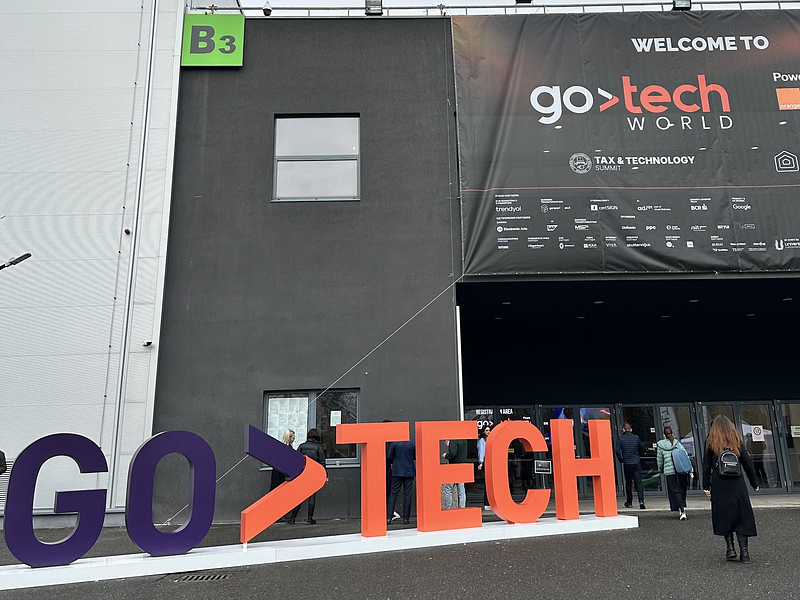
During the second week of November, I attended GoTech World, the largest B2B expo-conference in Central and Eastern Europe and my second tech event after DevCon earlier that month. I hadn’t planned to go, but I unexpectedly won an Instagram giveaway from Supertree, a coworking company that partnered with DevCon, so I embraced this opportunity!
Criteo R&D Supporting The DevOps Community At DevCon 2025
Author: Claire Dochez
medium.com
I participated only on the second day, November 12th, since I was mainly interested in the presentations rather than the B2B company booths. Two unique sessions on the Main Stage particularly caught my eye: a live performance by a robot cellist and a talk on 3D fashion that included mixed-fabric demonstrations, where the audience could touch 3D printed textile samples. I also enjoyed several talks on the Developers and Business & Transformation stages, especially those discussing Europe’s digital sovereignty and strategies for writing resilient tests.
Talks that got my attention
ROBOTICS SONATA feat. The Robot Cellist & Symphactory Strings
The day began with a really special moment on the Main Stage: a robot cellist performing live together with three musicians. Seeing a robot handle the music with that level of precision and nuance felt surreal in the best way, it was a memorable way to start the day and a great introduction to what was to come.

The robot cellist was created by Fredrik Gran, a Swedish composer, researcher, and pioneer in robotic musical performance. He explained that this robot, like his other creations, was not designed to replace human musicians. His goal is to explore new musical techniques and expand creative possibilities, especially in composition. He currently works with three different robots, and the one showcased at the event is the most portable, making it ideal for live performances.
One of the robot’s biggest advantages is its range of motion. With six joints and a circular structure, it can rotate its “hand” in ways that would be physically uncomfortable or impossible for a human player. This allows it to perform extremely fast passages, or, on the opposite end, very slow, perfectly even tones that even skilled musicians find challenging to sustain. Its flexibility also means it can be adapted to play different instruments. Over time, the robot has been tested with a variety of instruments, including trumpet, drums, and double bass, the instrument Fredrik himself plays
Although the creator is not primarily a programmer, he incorporated AI into the robot’s control system. He teaches the robot each piece individually, essentially training it to play one composition at a time. He also mentioned that he is open to collaborating with experienced developers to further evolve the project.
Europe’s Journey to Digital Sovereignty
Another topic that caught my attention was Europe’s journey toward digital sovereignty, presented by Schwarz IT, the company responsible for the digital infrastructure and software solutions behind Lidl and Kaufland supermarkets.
I had the opportunity to attend two presentations on this subject: one at the Business Transformation Stage, delivered by CEO, Octavian Ichim, and another at the Developer Stage, led by Senior Managing Director, Holger Schell. The first presentation provided a broad overview of how an organization can achieve digital sovereignty and reduce dependency on external technologies, while the second offered a deeper dive into Schwarz IT’s practical implementation of sovereign solutions across cloud computing, cybersecurity, AI, communication, and workplace innovation.

Octavian’s presentation explored the key question, “Can Europe control its digital future, or will it continue to depend on outside powers?” and pointed out several interesting aspects of Europe’s reliance on external resources:
- Exposure to vulnerabilities: rapid growth of AI, cloud platforms, and mass data flows, illustrated by crises such as Snowden, ransomware attacks, and Cambridge Analytica.
- Regulatory Responses: implementation of GDPR, NIS2, DSA/DMA, AI Act, DORA, that aimed at protecting citizens and strengthening resilience.
- Cybersecurity Challenges: Skills shortages, geopolitical tensions, and interconnected supply chains; 60% of organizations now factor geopolitical cyber-risk into strategy.

Holger, on the other hand, highlighted key tools and technologies used by Schwarz IT:
- StackIT: their sovereign cloud infrastructure, which provides a secure, European-focused cloud environment and supports internal and external applications while ensuring data sovereignty.
- ODJ (One Digital Journey): an infrastructure platform, unified for product teams and service delivery, which is not open source, but integrated into StackIT.
- Aleph Alpha Partnership: AI offerings hosted on StackIT which supports data-sovereign AI applications.
Also, he emphasized NEO as the foundation of Schwarz IT’s development approach, which focuses on breaking tasks into small, usable parts with short delivery cycles, enabling rapid results. He highlighted that they are defining stories that last no more than 3 days. Small, autonomous teams work within a coordinated structure, guided by principles that simplify decision-making while allowing flexibility when needed. Full transparency on quality, progress, and status allows them to optimize themselves and consistently meet specifications and deadlines.
The overall message was clear: Europe’s digital future isn’t guaranteed, it has to be built intentionally. This means not only making the rules but also creating, owning, and running the technology itself, with secure infrastructure, strong data protection, and innovation that reflects European values.
3D Printed Fashion: The future of fashion?
Another fascinating presentation at the Main Stage explored how 3D printing can merge technology and fashion to create new trends and innovations. It was delivered by Danit Peleg, a fashion designer who created the first commercially available 3D printed clothing.
She shared her experience producing the first home-made 3D printed fashion collection, working 24/7 and how she used different types of 3D machines through her career to increase the performance and use different materials. While printing small pieces, such as a 30×30 cm fabric, can take up to 15 hours, new machines that use pallets instead of filaments are speeding up production. She applied these techniques to create a custom dress for an Olympic dancer entirely remotely, needing to adjust only the length after the performer’s rehearsal.

Beyond improving production speed, sustainability was a central focus of her work as she emphasized a circular economy approach, using recycled materials and repurposing clothing at the end of its life by using pallets from recycled denim and TPU. She recommended combining traditional fabrics with 3D printed elements for accents and details, rather than creating entire garments entirely with 3D printing. She was wearing a mixed skirt during her presentation.
Danit also highlighted her collaborations with technology partners, including software that allows designers to send templates directly to 3D printers instead of using traditional garment patterns. She also uses AI to support her designs and has built a platform to sell her 3D printed pieces.
The audience even had the chance to feel the 3D printed pieces themselves, and it was great to see how many people were genuinely curious about this new idea.
From fragile to fearless: Writing tests that last
At the Developers Stage, Wouter Bauweraerts, a FullStack Developer, delivered an engaging presentation on writing durable, maintainable tests. He explained two types of unit tests: solitary and sociable. He highlighted that sociable tests are fast, focused on behaviour, easy to write, and run in isolation, making them far more resilient during refactoring. In contrast, solitary tests rely heavily on mocks and can quickly become fragile. However, integration tests still play an important role when validating full flows, security, infrastructure, or framework behaviour.
A key part of the session was UnitSocializer, a library developed by Wouter that automatically detects code changes and injects them into tests. This tool reduces setup overhead and makes sociable unit tests even more reliable.
He also delivered a live demo session where he demonstrated these concepts using a practical scenario based on the veterinary module of a demo application. He compared three types of test classes for the VeterinaryService:
- Solitary unit tests (using
MockitoExtensionin Java) - Sociable unit tests without UnitSocializer
- Sociable unit tests with UnitSocializer
After refactoring part of the service logic, all sociable tests. both with and without UnitSocializer, continued to pass. The solitary tests, however, failed as expected because their mocks were tightly coupled to the previous implementation. This clearly demonstrated how sociable tests withstand change far better.
GoTech World turned out to be far more inspiring than I expected, and each session offered a glimpse into how fast technology is evolving. I left the event feeling energised, curious, and grateful for the chance to attend and discover new things. It made me even more excited for future events and grateful to be part of this field.